Human EpCAM Protein Dimer, His Tag

Product Code: CSP-26323-01
Specificity: Human
Expression Host: HEK293T
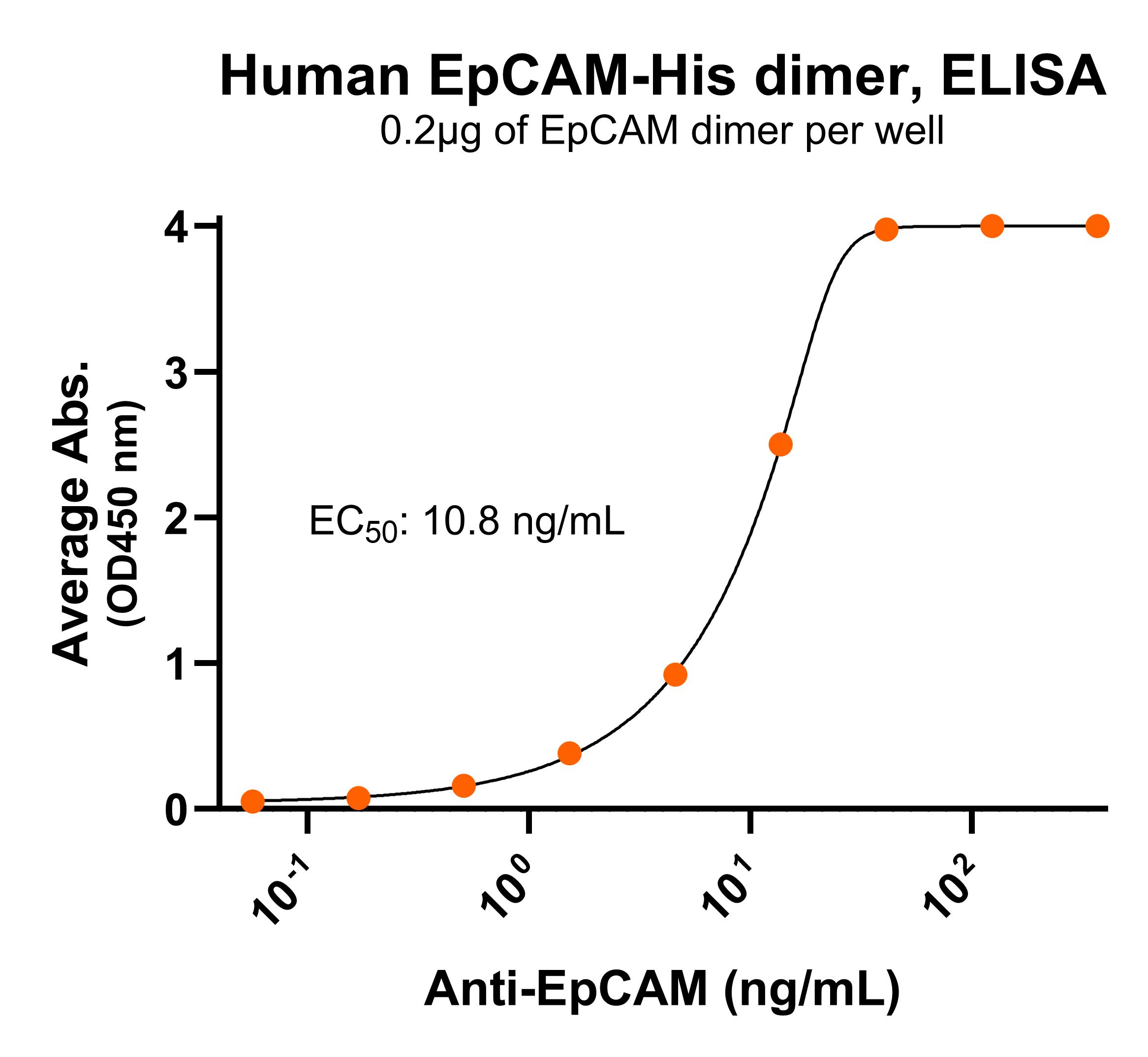
Verified Applications: ELISA for EpCAM-specific antibody binding assays.
Suggested Applications: SPR & BLI for EpCAM-specific antibody protein binding assays and CAR-T detection. Animal immunization, RUO.
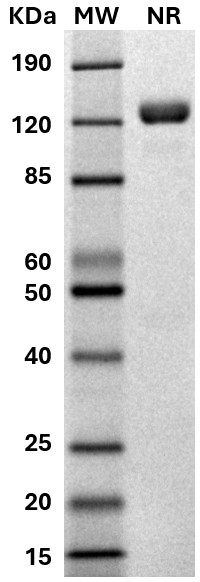
Purity: Greater than 90% dimer form as determined by SDS-PAGE under non-reducing condition
Amino Acid Range: Q24 – K265

For Research Use Only (RUO)

Add to Quote

Ready to buy now?
Email us at [email protected] and we’ll help you place your order directly.

Formulation: Lyophilized from 0.22 μm filtered solution in PBS, pH 7.4 with 10% trehalose as protectant
Shipping: Frozen Ice Packs
Storage: -20’C
Reconstitution Information:

For best performance, we strongly recommend you reconsitute the lyophilized product with deionized water to a stock solution of 500 µg/mL.
Solubilize for 20 minutes at room temperature with occasional gentle mixing. Avoid shaking or vortexing.

For 25µg product size:
Reconstitute with 50 µL sterile deionized water.

For 100µg product size:
Reconstitute with 200 µL sterile deionized water.

Human Epithelial Cell Adhesion Molecule (EpCAM) is a Type I transmembrane glycoprotein mediating Ca2+-independent homotypic cell–cell adhesion in epithelial cells. The recombinant EpCAM dimer protein (CSP-26323-01) is a cis-homodimer (cis-dimer) and contains an EpCAM extracellular domain (UniProt# P16422, amino acids Gln24 – Lys265) fused with a proprietary cis-dimer motif followed by a His tag at the C-terminus. This dimeric protein is expressed in HEK293T cells. The recombinant human EpCAM dimer protein is bioactive and can bind EpCAM-specific antibodies. This EpCAM dimer can be used as an antigen for in vitro assays and antibody screening, and as an immunogen for immunization to generate antibodies targeting more conformational epitopes.
Product Name: EpCAM, Protein Dimer
Predicted Molecular Weight: 71 kDa
SDS PAGE Molecular Weight: The migration range of the dimer protein with glycosylation under non-reducing conditions is ~120 kDa on SDS PAGE.
Protein Construct: EpCAM dimer protein contains an EpCAM extracellular domainfused with a proprietary cis-dimer motif followed by a His tag at the C-terminus.
Human Epithelial Cell Adhesion Molecule (EpCAM) is a Type I transmembrane glycoprotein mediating Ca2+-independent homotypic cell–cell adhesion in epithelial cells. EpCAM is also known as Cluster of Differentiation 326 (CD326). EpCAM contains an extracellular domain with epidermal growth factor (EGF) and thyroglobulin repeat-like domains sometimes referred to collectively as “EpEX” followed by a single transmembrane domain, and a short intracellular domain sometimes referred to as “EpICD”. High-resolution X-ray crystallography shows that the extracellular part of human EpCAM (EpEX) naturally assembles into a cis-homodimer. EpCAM is highly overexpressed in the vast majority of human carcinomas, including colorectal, breast, gastric, prostate, and lung cancers. Due to it being upregulated in many carcinomas and being exclusively expressed in epithelial cells and epithelial-derived neoplasms EpCAM is a diagnostic marker for several cancers. EpCAM also appears to play a role in tumorigenesis and metastasis of carcinomas, making it an emerging target of cancer therapeutics.

Alternate Names: Cluster of Differentiation 326, CD326, DIAR5, EGP-2, EGP314, EGP40, ESA, HNPCC8, KS1/4, KSA, M4S1, MIC18, MK-1, TACSTD1, TROP1, epithelial cell adhesion molecule, BerEp4, MOC-31, Ber-Ep4